


The heat resistance properties of parchment greaseproof paper make it an indispensable material for both commercial food service and home baking applications. As a superior alternative to standard parchment and baking paper, this specialized paper offers exceptional performance under high temperatures while maintaining its non-stick properties. Many professional kitchens now utilize custom printed greaseproof paper sheets that combine heat resistance with brand visibility, creating multifunctional solutions for modern food businesses. Understanding the thermal capabilities and limitations of these materials ensures optimal results in various cooking and packaging scenarios.
Heat Resistance of Parchment Greaseproof Paper
The thermal performance of parchment greaseproof paper depends on several key factors:
• Standard silicone-coated varieties withstand temperatures up to 420°F (215°C)
• Unbleached natural parchment and baking paper typically resists up to 450°F (230°C)
• Extended exposure to high heat may reduce effectiveness over time
• Thicker 40-50gsm papers maintain integrity better than thinner versions
• Quality variations exist between different manufacturing processes
• Performance differs between dry heat and moist heat applications
• Some premium grades feature reinforced edges for added durability
|
Specification |
Details |
|
Quantity |
500 sheets |
|
Paper Type |
White, 40gsm |
|
Colours |
1 Colour - Black or any other Pantone colour |
|
Shipping |
Available worldwide; shipping fees not included in the price. Submit your order first, and our freight team will provide multiple freight options. |
|
Lead Time |
30–35 Working Days / 10–15 Working Days |
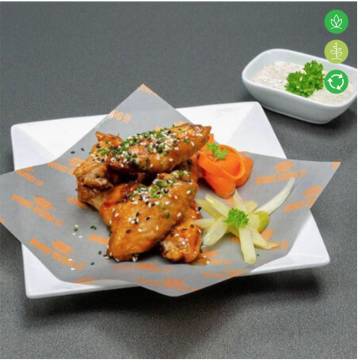
Applications for Printed Greaseproof Paper Sheets
Custom printed greaseproof paper sheets serve multiple heat-resistant functions:
• Branded bakery liners for cookies and pastries
• Professional kitchen portioning sheets
• Heat-resistant food wrapping for takeaway items
• Custom-sized sheets for specific baking pans
• Multi-layer applications in commercial ovens
• Reusable options for certain baking applications
• Specialized shapes for unique cookware
Comparing Parchment and Baking Paper
While often used interchangeably, parchment and baking paper have distinct characteristics:
• Traditional baking paper may lack silicone coating
• True parchment greaseproof paper undergoes special treatment
• Heat resistance varies by brand and composition
• Non-stick performance differs between products
• Some baking papers contain wax coatings unsuitable for high heat
• Professional kitchens typically prefer silicone-coated parchment
• Consumer-grade products may have lower temperature thresholds
Material composition and safety
The construction of quality parchment greaseproof paper ensures safe performance:
• Food-grade silicone coatings prevent sticking
• Bleached and unbleached fiber options available
• No harmful PTFEs or PFOAs in quality products
• FDA-compliant materials for direct food contact
• Some brands incorporate reinforced cellulose fibers
• Natural brown parchment contains fewer processing chemicals
• Reputable manufacturers conduct extensive heat testing
Printed Greaseproof Paper Sheets FAQs
Q: What’s the difference between parchment greaseproof paper and regular greaseproof paper?
A: Parchment greaseproof paper is coated with silicone, which enhances its non-stick properties and heat resistance, making it ideal for baking and high-temperature use (up to 220°C/428°F). Regular greaseproof paper lacks this silicone coating; it resists grease but isn’t non-stick and may not withstand extreme heat. Parchment greaseproof paper is reusable for multiple bakes, while standard greaseproof paper is often single-use for wrapping or lining.
Q: Are printed greaseproof paper sheets safe for direct contact with hot foods?
A: Yes, printed greaseproof paper sheets are safe for hot foods if they use food-grade inks and are designed for such use. Reputable manufacturers use heat-stable, non-toxic inks that won’t bleed or leach chemicals when exposed to warmth. However, avoid using them for extremely high-temperature applications (over 180°C/356°F) unless specified, as some inks may fade. Always check with suppliers to confirm heat tolerance for your specific use case.
Q: How does parchment and baking paper differ in usage from regular parchment paper?
A: Parchment and baking paper is a broad term often used interchangeably with regular parchment paper, as both are silicone-coated for non-stick performance. However, "baking paper" may sometimes refer to heavier-duty variants designed for repeated use or higher heat (up to 250°C/482°F). Regular parchment paper works for most baking needs, while specialized baking paper may offer extra durability for tasks like roasting or baking acidic foods (e.g., tomatoes).
Q: Can printed greaseproof paper sheets be customized with specific designs, and what limitations apply?
A: Yes, printed greaseproof paper sheets can be customized with logos, patterns, or text using food-safe inks. Common options include single-color prints (like black or Pantone shades) and custom sizing. Limitations include minimum order quantities (often higher for custom designs) and design complexity—intricate details may require higher resolution artwork. Additionally, metallic or neon inks are rarely food-grade, so stick to standard food-safe color options for safety.
Q: When should I choose parchment and baking paper over parchment greaseproof paper?
A: Choose parchment and baking paper for tasks requiring maximum non-stick performance and heat resistance, such as baking cookies, roasting vegetables, or lining cake tins. It’s also ideal for messy or sticky foods that might adhere to surfaces. Parchment greaseproof paper, while similar, is often thinner and better suited for lighter uses like wrapping sandwiches, lining trays for cold foods, or as a cost-effective option for moderate-heat baking (up to 200°C/392°F). Both are silicone-coated, but baking paper typically offers enhanced durability.
